Flagship · In development
HERCOSS Exxo A1
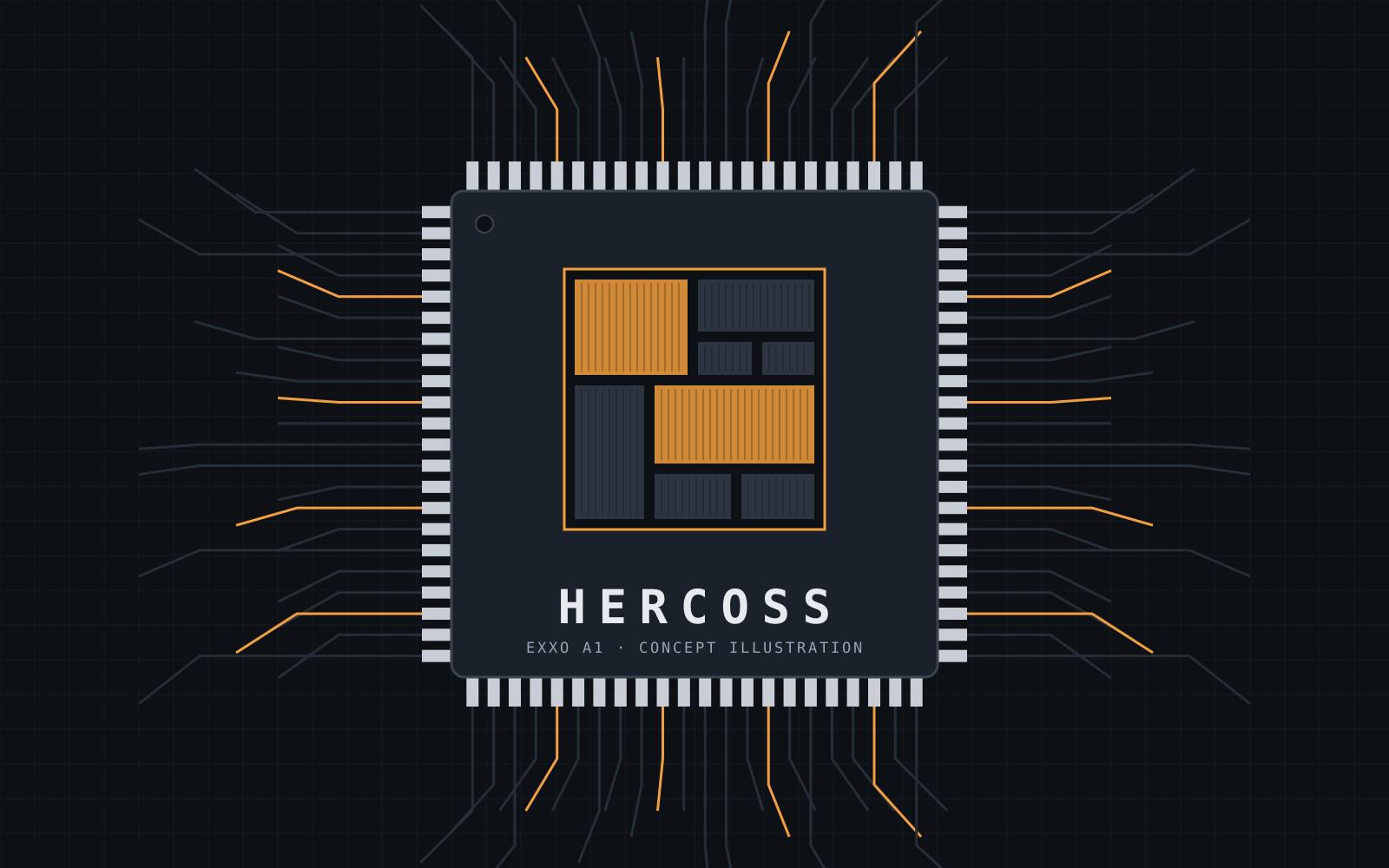
A complete FPGA SoC for space: sixteen RISC-V processors, an FPGA fabric and a full set of space-grade peripherals on a single chip, designed in Europe.
- 16 × RV64IMAC
- ~500K-LUT FPGA fabric
- 3 × PCIe Gen5 x16
- 300 krad target
What is an FPGA SoC?
A satellite’s on-board computer usually needs two kinds of chip. A processor runs the software: the operating system, the mission logic, the communications. An FPGA is hardware that can be rewired after it is built, used for the jobs software is too slow for, such as handling instrument data in real time.
An FPGA SoC puts both on one piece of silicon. That saves board area, mass and power, and lets software and custom hardware exchange data at full speed instead of across slow board-level wiring.
Why Hercoss is building one
Europe’s upcoming space missions depend on chips of this class, and today they come from a very small number of suppliers outside Europe. The Exxo A1 is Hercoss’s answer: a chip built on open standards, designed with the smallest possible die area, and intended to be designed and manufactured in Europe.
Where does the project stand today?
The A1 is in development: its architecture and RTL are being designed and verified in simulation. It has not been fabricated. The figures on this page are design targets. What has already been proven on real hardware are its building blocks, the eFPGA fabric and the IP cores; see the roadmap below.
Explore the chip
Click any block to see what it does and why it is there.
Sixteen 64-bit RISC-V processors
The A1 integrates sixteen RV64IMAC cores. RISC-V is an open instruction set: it does not depend on licences from a single vendor, which matters for a chip built around technological sovereignty.
- Up to 16 independent Linux instances, one per core.
- AMP and SMP can be mixed: some cores work together while others stay isolated.
- Runs bare-metal software and real-time operating systems (RTOS) from several vendors.
- Communication between domains through remoteproc/RPMsg.
An FPGA inside the chip itself
Next to the processors sits a programmable logic fabric with a target of about 500,000 LUTs. It is hardware that can be redefined after the chip is manufactured, even with the satellite already in orbit: bugs get fixed and functions get added without new silicon.
- FPGA fabric of Hercoss's own design, not licensed from an FPGA vendor.
- Hercoss IP cores are offered both as hard IP (fixed in silicon) and as soft IP (loadable into the fabric).
- A first, reduced version of the fabric already runs and has been taken to layout: see the eFPGA fabric project.
Acceleration for AI and attitude control
A dedicated compute array brings together what other chips keep as separate blocks: AI engines, neural processing units and the satellite's attitude determination and control (ADCS) algorithms.
- Convolutional networks (CNN) and spiking networks (SNN), among others.
- Processes data on board instead of downlinking all of it to the ground.
Security ready for the quantum era
A satellite can operate for ten years or more. Communications protected today with classical cryptography could be decrypted by a future quantum computer, so the A1 includes accelerators for the newly standardized algorithms.
- ML-KEM for key exchange and ML-DSA for digital signatures.
- Secure key zeroization in the flight variant.
One bus for the whole chip
Every element of the A1 connects through full AXI4, with no reduced versions of the protocol. Processors, FPGA fabric and peripherals speak the same language, which makes it simpler to integrate new blocks and reuse existing IP.
- Same interface for hard IP and soft IP.
- An open standard with broad tool support.
Three 16-lane PCI Express Gen5 interfaces
PCI Express is the standard way to attach storage, accelerators or other chips. Three Gen5 x16 interfaces give the A1 the bandwidth for payloads that move large volumes of data.
- Gen5: 32 Gbit/s per lane.
- Compatible with existing commercial hardware.
High-speed serial links
Hercoss's Ethernet and SerDes cores provide the chip's network connectivity. They are already tested on FPGA against commercial hardware.
- 25G and 40G Ethernet with Hercoss's own MAC and PCS.
- Multi-lane SerDes with its own 64B/66B line coding.
- PTP / IEEE 802.1AS time synchronization.
The buses the space industry uses
A satellite is built around buses with decades of flight heritage. The A1 integrates them so it connects directly to existing instruments and equipment, with no additional chips.
- SpaceWire, ESA's standard link for instrument data.
- MIL-STD-1553, a high-reliability command and control bus.
- CAN and USART for subsystems and maintenance.
Ten 24-bit analog-to-digital converters
Real-world sensors deliver analog signals. Ten 24-bit sigma-delta converters read them at high resolution without external components.
- Sigma-delta architecture: high resolution from little analog circuitry.
- Intended for attitude sensors, telemetry and instruments.
One design, two variants
Commercial variant
The commercial version of the chip: the same architecture and the same software, without the radiation hardening.
Hardened variant for deep space
The same design with radiation protection on the configuration, the memories and the registers. The figures are design targets.
| Total ionizing dose (TID) | 300 krad |
|---|---|
| Mission | GEO and interplanetary |
| Lifetime | 10 years |
| Operating temperature | −55 °C to +125 °C |
Roadmap
Done In progress Planned
Own eFPGA fabric running on FPGA
The first version of the fabric runs inside a commercial FPGA and passes the runtime reconfiguration self-test.
eFPGA fabric taken to layout (GDS)
Implemented in the European IHP SG13G2 process with an open-source flow. It passes the official IHP precheck with no LVS, antenna or timing errors.
IP core family validated on FPGA
The cores are tested in simulation and on real hardware. In progress: a full review to make them ready for the chip.
A1 architecture and RTL
Design of the complete SoC and verification in simulation.
Emulation on a larger FPGA
The full design no longer fits the current development board; the next step is a larger platform.
Test chip
Fabrication of a first test chip in SG13G2.
HERCOSS Exxo A1: COTS variant and rad-hard variant
Fabrication of the complete chip, with the goal of doing it in Europe.
Hercoss design tools
The user environment for programming the chip: a graphical interface and a command-line flow.
Get in touch
Hercoss is looking for European cooperation to take the A1 from design to a working chip.